

Quick answer
Use a Shopee review scraper for Shopee review data extraction from a supported product page, then segment the local dataset by rating, date, variation, text, media, and seller response. To analyze Shopee reviews responsibly, build a repeatable issue taxonomy, quantify recurring themes, and keep each finding linked to the source review so it can be verified.
Review analysis is a research method, not a verdict. Sampling, product variants, campaign timing, delivery experience, and seller operations can all affect what buyers report. Preserve the context and avoid collecting unnecessary personal information.
- Define the decision before collecting reviews.
- Separate product quality from variation, delivery, and seller issues.
- Read representative source reviews behind every summary.
- Report sample size and collection date with the findings.
Define the product decision before collecting reviews
Start with a specific decision: compare product variations, identify packaging failures, evaluate sizing consistency, monitor a supplier change, or discover language customers use to describe a problem. A precise question determines which reviews, dates, ratings, and fields are relevant.
Write the inclusion rule before extraction. For example: public reviews from the last six months for all color variants, or a balanced sample across one- to five-star ratings. Avoid changing the rule after seeing the data unless the change is documented as a separate analysis.
Review data cannot prove product performance by itself. Buyers self-select into reviewing, platform displays can change, and delivery or seller service may influence a rating that appears on the product page. Treat the dataset as evidence to investigate, not a statistically complete population.
Collect more than the review text
Useful review analysis includes rating, text, date, product variation, helpful count, images, video, seller response, product identifier, and source URL. These fields help separate a general product issue from a specific size, color, model, batch, packaging method, or delivery experience.
Open the supported product page, wait for the review area to render, choose review extraction, and set a reviewed limit. Free behavior follows the current rendered workflow and product limits; Pro can provide additional filtering, local dataset retention, and export options according to the active plan.
If verification appears, stop and complete only permitted manual steps. AI Shopee Data Extractor – CTC Shopee does not bypass login, CAPTCHA, traffic verification, or private access. Record incomplete jobs as partial samples rather than silently treating them as the complete review history.
Build a defensible review sample
Recent reviews are useful for detecting current operational changes, but a recent-only sample can miss durability problems that appear after months of use. A low-rating-only sample reveals failure modes but cannot estimate the overall customer experience. Select a mix that matches the question and state the tradeoff.
Stratify by star rating, date range, and product variation when those dimensions matter. If one variation has far more reviews than another, report counts rather than comparing percentages without context. Remove exact duplicates, but preserve similar reviews when they represent separate buyer experiences.
Record the product URL, market, collection time, total visible review context, selected filters, and number of extracted records. This makes the analysis reproducible and prevents a later reader from mistaking a filtered spreadsheet for all reviews.
Segment before summarizing
Split reviews by rating, variation, time period, presence of text, media, helpful count, and seller response. Recent one-star reviews can reveal operational changes that disappear inside an overall average, while repeated three-star comments often expose compromises that satisfied and dissatisfied buyers describe differently.
Separate product themes from fulfillment and service themes. Quality, sizing, compatibility, durability, and accuracy describe the item; packaging, delivery, missing parts, responsiveness, and refund handling may describe the seller or logistics experience. Mixing them produces vague conclusions that are hard to act on.
Compare segments before calculating a combined theme count. A complaint concentrated in one size or date range requires a different response from the same words appearing across every variation and month.
Create a repeatable issue taxonomy
Create a short codebook before tagging the full dataset. Define themes such as material quality, fit or sizing, color accuracy, compatibility, durability, packaging, delivery, missing parts, ease of use, and seller support. Add an Other or Unclear category rather than forcing ambiguous text into a preferred theme.
Allow more than one tag when a review contains distinct issues, but distinguish the primary issue if you plan to count affected reviews. Write an inclusion example and an exclusion example for each theme so another analyst can apply the same rule.
Keep the source review, rating, variation, and date linked to every tag. Summaries and AI-assisted clustering can accelerate review, but a human should be able to open representative source text and verify that the label reflects what the buyer actually wrote.
Quantify themes without overstating the result
Count unique reviews associated with each theme and report the denominator. Twenty packaging complaints means something different in a sample of fifty reviews than in a sample of five thousand. Show raw counts alongside percentages and label filters that excluded blank-text or media-only reviews.
Track theme rate over time or by variation when the sample supports it. A sudden increase after a specific month can guide investigation, but it does not prove the cause. Check whether review volume, campaign mix, seller, logistics, or product version changed at the same time.
Quote short representative excerpts only when necessary and remove unnecessary personal information. Do not present the most dramatic comment as typical unless the counts support that claim.
Use media and seller responses as supporting evidence
Images and videos can clarify damage, color, scale, assembly, or packaging that text describes poorly. Treat them as supporting evidence tied to a specific review, not as a general product asset. Media can contain faces, addresses, order labels, or other personal details that should not be copied into a report.
Seller responses help distinguish acknowledged defects, usage guidance, replacement offers, and disputed claims. Analyze the response separately from the buyer's issue so a reply does not erase the original report or count as an independent customer opinion.
An exported media file does not grant permission to republish it. Follow platform terms and applicable rights, and keep only media required for the authorized research purpose.
Use results responsibly
Review data is a research input, not proof that every buyer will have the same experience. State the product, market, collection date, filters, sample size, and known limitations alongside every conclusion. Keep positive, neutral, and negative evidence visible when the question concerns overall experience.
AI Shopee Data Extractor – CTC Shopee stores datasets in the current Chrome profile and does not upload them to CTC. Local storage reduces unnecessary transfer but still requires device security, controlled access, and deletion when the analysis ends.
Export CSV for a portable flat table, XLSX for analyst-friendly filtering and typed columns, or JSON when nested review and media structure must be preserved. Keep a raw export, perform transformations in a separate working copy, and document the taxonomy version used in the report.
Shopee review scraper FAQ
How do I export Shopee reviews?
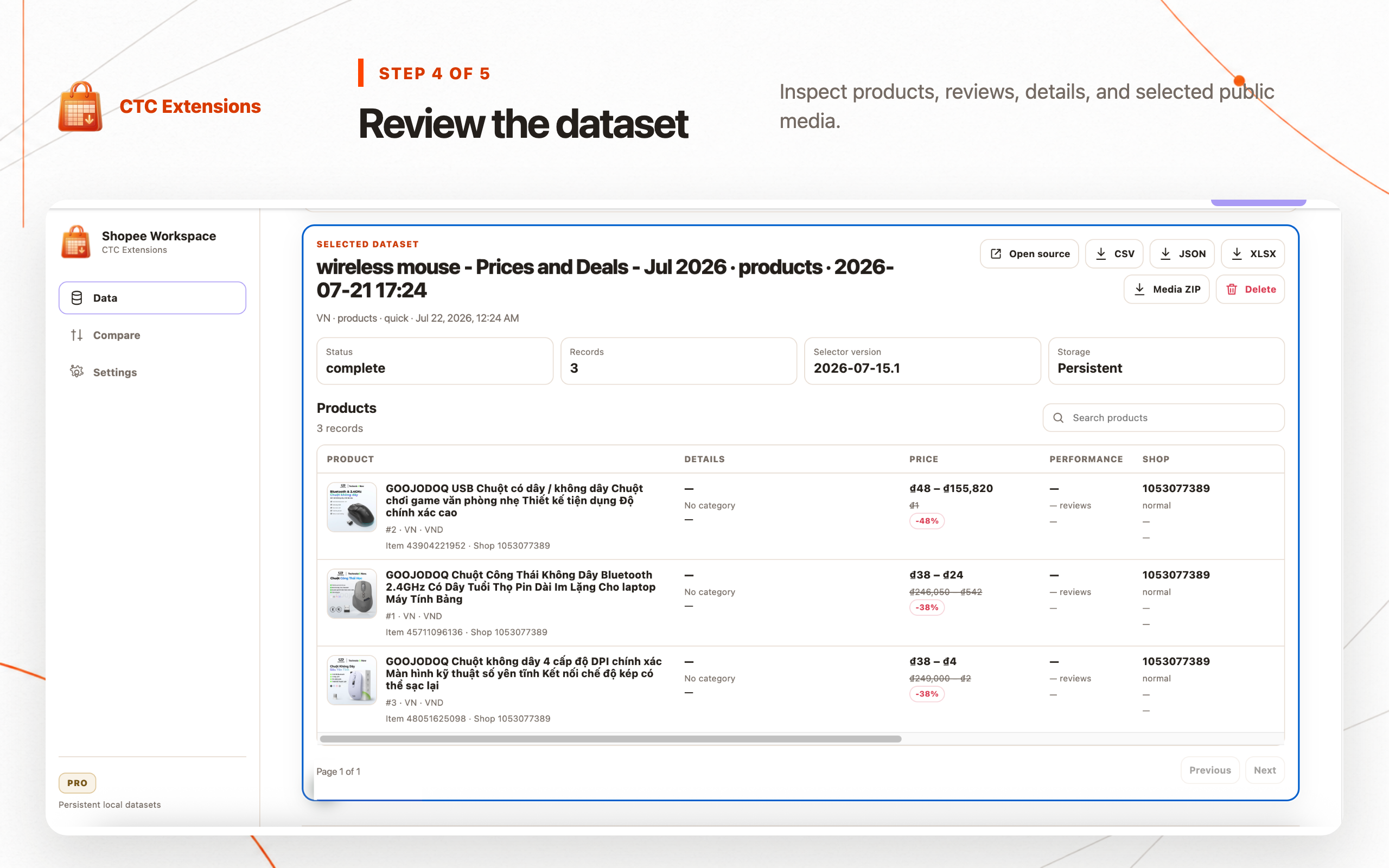
Open a supported Shopee product page, choose review extraction, set a reviewed limit and filters, start the user-controlled job, inspect the local dataset, and export the required format. Review availability and fields depend on what the page renders.
What fields are useful for Shopee review analysis?
Useful public fields include rating, review text, date, product variation, helpful count, images or video, seller response, product identifier, and source URL. Keep only fields required for the research question.
Can a Shopee review scraper bypass verification?
No. AI Shopee Data Extractor – CTC Shopee does not bypass login, CAPTCHA, traffic verification, or other controls. Stop when verification appears and continue only through normal, permitted user interaction.
How many Shopee reviews should I analyze?
There is no universal number. Choose a documented sample that covers relevant ratings, dates, and variations. Report the sample size and avoid presenting a small or filtered subset as the complete buyer experience.
Can I use review media in marketing?
An export does not grant reuse rights. Review images and videos can contain personal or copyrighted content. Use media only for the authorized research purpose and follow platform terms, applicable law, and the rights of the original creator.